From the Director's Desk: PFI on Capitol Hill Last Week, Congressman Huizenga Tours Michigan Wood Fuels, Economic Advantage of Wood Pellets Amplified This Season, Northern Forest Center Releases Wood Heat Video
PFI on Capitol Hill Last Week
Last Tuesday and Wednesday, Matt Klein (Easy Heat), Pat Rita (Orion Advocates) and I spent time on Capitol Hill. We targeted the legislative staff of the 13 House members that voted against a farm bill amendment that would have changed the definition of “renewable biomass” within the Clean Air Act to include mill residuals. For now, the definition really only impacts eligibility for participation in the Renewable Fuels Standard and the Renewable Fuels Standard is limited to transportation fuels.
The PFI’s position is that any definition in federal code that seeks to define “renewable biomass” must include mill residuals. If the trees that flow into sawmills are renewable, and they most certainly are, then the residues produced while converting those trees into dimensional lumber and other forest products are renewable too. Federal policy is highly referential. A definition of “renewable” for the Renewable Fuels Standard might one day be the reference for some other program. It isn’t too difficult to imagine that a future administration might want to revisit the Clean Power Plan or a national Renewable Portfolio Standard where renewable energies across the economy are favored and incentivized. With outdated definitions still on the books, wood pellets for space heating might find itself on the outside looking in.
In total, there were 11 members representing PFI member districts that voted no on the amendment to reclassify mill residuals as renewable. Our aim was to spend some time asking “why?” An entire congressional cycle might come and go without a single vote that is relevant in our sector, so we wanted to use this vote as an opportunity to better understand what these representatives knew about the amendment, about biomass and about wood pellet manufacturing in their district.
We heard plenty that we already knew. Pulp and paper interests were out in force against this definition, fearful that a reclassification of mill residues might create an imbalance in the price of fiber. Additionally, long time pellet antagonists reached out to every office, advancing their narrative of pellets or renewable fuels made from wood fiber as a consumptive, depleting product that drives deforestation in the United States. When staffers shared with Matt and me the outreach they had received from these interests, it solidified my belief in the importance of federal advocacy. Make no mistake: your industry is being talked about in Washington. Trade organizations like the Pellet Fuels Institute are vital in ensuring that misinformation is countered with the real story.
This seems like a great segue to a companion story of sorts, that of a U.S. Representative visiting an operating wood pellet operation.
The only thing better than explaining just how a wood pellet operation fits into an area and boosts the bottom line of upstream sawmills and forest product manufacturing sites is SHOWING a representative that site personally.
Congressman Huizenga Tours Michigan Wood Fuels
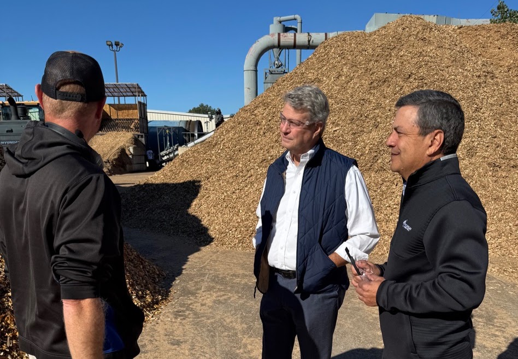
Rep. Bill Huizenga (R-MI-4) visited Michigan Wood Fuels in Holland last week and got a firsthand look at how the company turns sawmill residuals into clean, renewable heating fuel. The visit is a reminder of one of the most effective advocacy tools PFI members have: an open door.
Policymakers hear from dozens of industries every week, usually in a crowded Capitol Hill office with a fact sheet and fifteen minutes on the clock. A facility tour is different. On the floor of a pellet mill, a member of Congress sees the fiber arriving from local sawmills, the equipment and quality controls that produce a consistent fuel, and the people whose jobs depend on it. Those details stick in a way talking points rarely do.
Site visits also build relationships that last long after the tour ends. When a pellet issue comes up in committee or on the floor, a lawmaker who has stood inside of a pellet plant in their own district knows who is affected. Staff who joined the tour know exactly whom to call with questions.
PFI encourages every member company to invite its representatives and senators for a visit. District work periods and congressional recesses are ideal windows. PFI staff are glad to help with invitations, logistics, and briefing materials so each visit makes a lasting impression.
Thank you to Congressman Huizenga for making the trip, and to Ben Rose and the entire Michigan Wood Fuels team for hosting.
Economic Advantage of Wood Pellets Amplified This Season
Earlier this month, Bill Strauss at Future Metrics sent me a line graph that tracked the price of heating oil since 2013, and juxtaposed those price fluctuations against a baseline of heating pellets and their delivered BTUs when sold for $380 retail. The results are compelling and underscore one of the longtime attributes of wood pellet heating that wins new pellet consumers and retains those that already own pellet appliances: price stability.
Wood pellets are not immune from price increases and inflationary pressures. A quick survey of the wholesale price within the Monthly Densified Biomass Fuel Report archives will quickly illustrate that. Our industry is certainly exposed to the dramatic uptick in diesel pricing that our economy is currently suffering through, and those increased shipping prices ultimately are borne by the end consumer. Still, despite the increased costs of “landed pellets” (price of the product + the price of shipping), consumers using wood pellets this year are currently heating their homes at about a 40% discount from heating oil. I used the PFI’s heating fuel calculator to arrive at this percentage. For the calculation, I used a price of $400/ton for wood pellets and $6/gallon for heating oil. For appliance efficiencies, I used 78% for wood pellets and 87% for an oil boiler. The calculator is available on the PFI website and is linked for your use in the Industry News section of this website.
Bill’s chart makes this point too, but also shines a bright light on the volatility of heating oil. As recently as last year, with heating oil retailing around $3.50 – 3.75/gallon, pellets and oil were more or less at parity. This raised eyebrows across the industry as one of the hallmarks of wood pellet heating, its price advantage, was largely gone.
What a difference a year makes. Wood pellets are not completely insulated from global events. Almost no consumer goods are, but this season those consumers heating their homes with wood pellets are doing so at nearly half the price of their heating oil neighbors.
These price spikes tend to encourage fuel switching with those consumers that possess both oil and pellet (or cordwood) heating appliances and also create a very favorable environment for wood pellets with those consumers seeking a new heating solution.
Northern Forest Center Releases Wood Heat Video
In mid-September, the Northern Forest Center, via its Feel Good Heat initiative, produced a very professional-looking video highlighting the advantages (economic and environmental) of using wood and wood pellet heating for larger, commercial buildings. The video features a number of chip and pellet technologies including PFI-member Maine Energy Systems. The video does an excellent job of highlighting the locality of wood heating and its cost advantage. The video is linked in the Industry News section of this edition of the Pellet Wire. Please distribute it to your professional network.